
Notifications
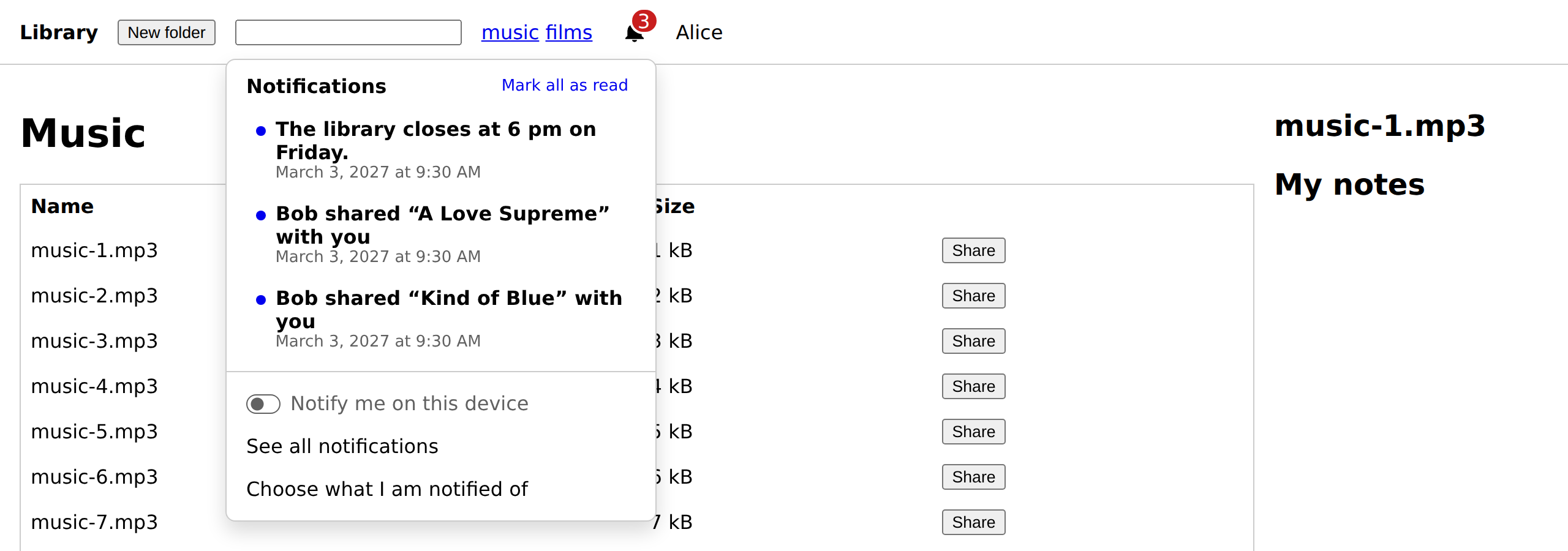
A bell on every page tells a user what concerns them: a count of what they have not read, the latest notifications, and a page of them all. A page hears of a new one at once, over the stream it already holds; a browser with no page of the application open is sent a system notification through web push. Each notification belongs to a topic its reader may unsubscribe from. Notifications are off until notifications is configured, and every part of them is optional.
Setting them up
# config/packages/collaborate.yaml
collaborate:
    notifications:
        role: ROLE_USER             # null: collaborate.role
        topics:
            shares:
                label: 'Shares'
                description: 'A record is shared with you.'
            announcements:
                label: 'Announcements'
                mandatory: true      # nobody unsubscribes
        types:
            record_shared:
                topic: shares
                # A translation key; a % is written %% in the configuration.
                sentence: '%%name%% shared “%%record%%” with you'
                label: 'Shared records'   # the filter of the page
icon: 'fa fa-share' # classes of an icon, or null// config/routes/collaborate.php: the routes, under the prefix the host wants
$routes->import('@CollaborateBundle/config/routes/notifications.php');{# in the layout, where the bell goes #}
{{ collaborate_notifications() }}
{{ collaborate_layer() }}import '@janalis/collaborate/notifications/bell.js';
// on the page of all notifications, and on the page of the topics:
import '@janalis/collaborate/notifications/page.js';
import '@janalis/collaborate/notifications/topics.js';@use 'collaborate/assets/scss/notifications';The three tables are mapped only while notifications are on: create collaborate_notification, collaborate_notification_preference and collaborate_push_subscription with a migration (their SQL is in docs/schema.sql). A recipient is the id the collaborator provider gives, with no foreign key: an application may add one to its user table, ON DELETE CASCADE, or call NotificationRepository::forget($id) when it removes a user.
Telling someone
public function __construct(private Notifier $notifier) {}

$this->notifier->notify($user, 'record_shared', ['%name%' => 'Bob', '%record%' => 'Song'], '/library/music');
$this->notifier->notifyAll($administrators, 'record_shared', $parameters);
notify() takes a user or their id, the name of a configured type (any other throws), the values of the placeholders of its sentence and where a click leads. It saves the row (flushing the entity manager, so do it once what it tells is saved), then tells the pages of its reader through the hub that their list changed. The hub carries no content: the pages ask for their list again. A user who left the topic of the type is told nothing, and nothing is flushed for them: flush what you save yourself rather than count on notify() to do it. With a bus, nothing is flushed either.
The bell and the pages
collaborate_notifications() renders nothing for a visitor nor for a user without notifications.role. Its menu lists the latest (20) notifications; the count stops at max_count (99+). Following one marks it read first. The page of them all (<prefix>/notifications/all) lists page_size (30) at a time as its reader scrolls, filtered by unread, type or topic, and reads, unreads or clears one or all of them. A host whose layout fills another block than body names its own template in page_template and topics_template, including @JanalisCollaborate/notifications/_page.html.twig and _topics.html.twig where its layout wants them.
The scripts dispatch two events on document for the host:
collaborate:notification({id, text, url}), once per new notification, whether a page heard of it through the hub or from the service worker: a host shows a toast or announces it.collaborate:notifications-changed({unread, total, origin, heard}), after any change.
The styles are the module's custom properties (--collaborate-notifications-accent, -bg, -fg, -muted, -border, -badge-bg, -badge-fg, -radius, -shadow, -font), which a host maps onto its own colours; they follow the colour scheme of the system by default. The accent is both text on -bg and the background of -bg text (the active filter): give it a contrast of 4.5:1 or more with -bg in both colour schemes.
The stream of a page
A page hears of its notifications over the one subscription its layer already opens. A page with no cursor room (a page the place provider puts in no place, or a user who holds notifications.role but not collaborate.role) is given a bare grant: its stream carries the notifications of its user alone, no cursors nor saved views. A host that keeps notifications off sees no difference. A host whose hub may be missing names a Janalis\Collaborate\Notification\StreamGuardInterface in notifications.stream_guard: while it says no, no bare grant is given, and the bell shows what was told before the page loaded.
Topics
Every type belongs to a topic, which its reader subscribes to or unsubscribes from on <prefix>/notifications/topics. Unsubscribed, a user is told nothing of the topic: no row, no bell, no push. A topic is on by default (default: true); a mandatory one cannot be left. Choices are stored only when made, and changing a topic needs the CSRF token of the page: a forged unsubscribe would silence its user.
Messenger
With symfony/messenger installed and notifications.bus naming a bus, notify() dispatches a SendNotification per recipient instead of writing. Route it like any message:
framework:
    messenger:
        transports:
            async: '%env(MESSENGER_TRANSPORT_DSN)%'
        routing:
            Janalis\Collaborate\Notification\Messenger\SendNotification: async
            Janalis\Collaborate\Notification\Messenger\SendWebPush: async
A message holds scalars alone, and is dated when it was sent. Its key makes handling it idempotent: a redelivered message writes no second row. Each browser to push to is a SendWebPush of its own, retried by Messenger. What a worker or a console command publishes is sent once its message or command is done; the hub (with the WebSocket hub, its publish_url) must be reachable from the worker.
Web push
When no page of the application is open, a browser is sent a system notification. The bell of a browser that can shows Notify me on this device, which asks the browser's permission only when it is clicked.
composer require minishlink/web-push:^11.0 nyholm/psr7
php bin/console collaborate:push:setup --subject=mailto:ops@example.org
The command makes a VAPID key pair and writes it, with its subject, into .env.local (--env-file names another; --vault seals them in the secrets vault of the environment instead; --format=env|json prints them only). It refuses to replace configured keys without --force: browsers subscribed with the former key are pushed to no more, so --force also removes their subscriptions, unless --keep-subscriptions. It prints the configuration that reads them when web push is off:
collaborate:
    notifications:
        web_push:
            enabled: true
            public_key: '%env(WEB_PUSH_PUBLIC_KEY)%'
            private_key: '%env(WEB_PUSH_PRIVATE_KEY)%'
            subject: '%env(WEB_PUSH_SUBJECT)%'
collaborate:push:setup --check checks the configured pair and subject, and exits non-zero on a problem: a deployment calls it.
In the page its reader looks at, else in the system. The service worker (<prefix>/notifications/push/worker.js, allowed to control the whole origin) shows a push in the page of the application that has the focus (its bell tells the host, which shows a toast), and as a system notification whenever none has it: every page closed, hidden, or behind another window. The pages left open count it through the hub without saying it, so it is never shown twice. A click on a system notification marks it read and opens where it leads. skip_online (off) pushes nothing to a user whose page holds the stream of their notifications, focused or not, asking the hub: Mercure's subscriptions API (subscriptions on in the hub's configuration), or the WebSocket hub's own, which needs no setting.
What a push says is the sentence of the notification, translated in the language of its reader (a Janalis\Collaborate\Notification\RecipientLocaleProviderInterface named in notifications.locales; the default locale otherwise), encrypted to the browser, through the push service of its vendor. payload: none sends an empty push instead, and the worker says a generic sentence.
- The server reaches the push services (Google, Mozilla, Apple) over HTTPS.
- On iOS and iPadOS, only a web app added to the home screen receives pushes: the bundle ships no manifest.
- A host with a service worker of its own names it in
service_worker, andimportScripts()the bundle's after settingself.collaborateNotificationsas the bundle's route does. - A browser whose subscription its push service says is gone (404, 410) is forgotten; a subscription is re-attached to whoever signs in on the browser, and refreshed when the keys change.
- Subscribing needs the CSRF token of the page: a forged subscription would hand the notifications of its user to an endpoint of the forger's.
- The server posts to the endpoint a browser hands it, so only an endpoint of a push service is accepted (
endpoint_hosts: Google's, Mozilla's, Apple's and Microsoft's by default, their subdomains included), https on the default port; a host behind a push service of its own adds its host.