
REST API
The API lives under /api, next to the OAuth 2.0 token endpoint /oauth/token. Its OpenAPI 3.1 description is at /api/openapi.json.
The port decides which listener serves the API:
- Same port as the admin UI (the default;
api.port = 0meansadmin.port): one listener serves both. - Another port: the API gets its own listener, on
api.listen(defaultadmin.listen) andapi.port, with a/healthzendpoint. The admin listener then no longer answers/api, so each can be exposed to different networks. - Admin UI disabled: the API keeps running on its own listener.
# 1. Create an API client in the admin ("API clients"), or with the CLI.
#    The secret is shown only once.
redirect-proxy client add deploy --scope redirects:write

# 2. Get an access token (client credentials grant).
TOKEN=$(curl -s -u "$CLIENT_ID:$CLIENT_SECRET" -d grant_type=client_credentials \
  http://localhost:8081/oauth/token | jq -r .access_token)

# 3. Call the API.
curl -s -H "Authorization: Bearer $TOKEN" -H 'content-type: application/json' \
  -d '{"source": "/old", "target": "https://example.com/new", "status": 301}' \
  http://localhost:8081/api/redirects
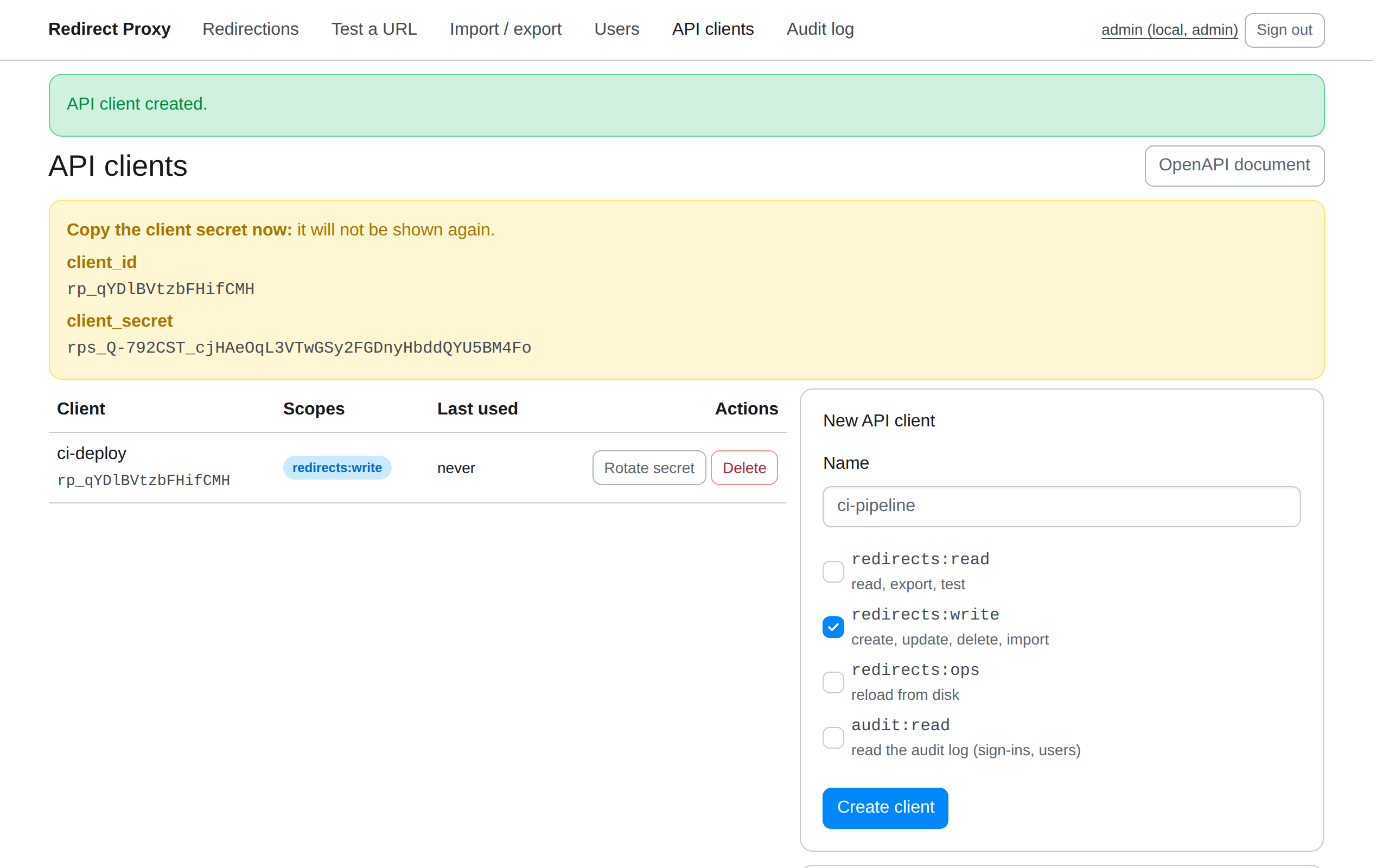
The admin's API clients page creates clients, rotates their secrets and shows how to call the API. A new secret is shown once:
| Endpoint | Scope | |
|---|---|---|
GET /api/redirects | redirects:read | Filters q, host, match, enabled, tag; sort by source, host, hits, last_hit or updated (- for descending); pages via page and per_page (positive integers; per_page above 500 gets 500), with a Link header and meta.has_more, as in /api/audit. Invalid values answer 400. Rules include their hits and last_hit_at. The ETag is the version of the whole rule set. |
POST /api/redirects | redirects:write | Create. Returns 201, Location and ETag. An optional id (up to 128 letters, digits, ., _, ~ or -, and not new, bulk, export, import, . or ..) makes a retry safe: the same id again answers 409 with Location pointing to the rule, instead of creating a second one. |
GET / PUT / PATCH / DELETE /api/redirects/{id} | read / write | PATCH is a JSON merge patch. All writes honour If-Match (412 on mismatch) with the rule's ETag. With api.require_if_match, every write (PUT, PATCH, DELETE, bulk and import) without If-Match answers 428; without it, PATCH still guards itself against a change made between its read and its write. GET always answers 200: its body has the live hits and last_hit_at, which the ETag (the version of the rule's settings) does not cover. |
GET /api/redirects/export | redirects:read | Same format as redirects.json, or CSV with format=csv. Takes the list filters (q, host, match, enabled, tag). The ETag is the version of the whole rule set and If-None-Match answers 304 (the export has no hit counts; the list, which has them, does not answer 304). |
POST /api/redirects/import?mode=merge|replace | redirects:write | All or nothing, as application/json or text/csv. Rules imported unchanged keep their ETag, dates and author. dry_run=true returns what would be added, changed and removed without writing, with an ETag: send it in If-Match to apply exactly that change (412 if the rules changed meanwhile). |
POST /api/redirects/bulk | redirects:write | {"ids": [...], "action": "enable|disable|delete"}, all or nothing. Honours If-Match with the version of the rule set. |
POST /api/reload | redirects:ops | Re-read redirects.json from disk. |
GET /api/test?url= | redirects:read | Which rule matches a URL and where it redirects, every matching rule with its verdict (applied, shadowed, disabled, out_of_schedule, or refused when its substitution would leave its target's host), and the redirect chain. |
GET /api/audit | audit:read | Audit entries as recorded, newest first, from the current and rotated files. Filters actor (exact), action (prefix: rule.), target (contains), since and until (RFC 3339); pages via page and per_page (max 500), with meta.has_more and a Link header for the next page. |
Scripted changes
Every write (create, update, delete, bulk, import) checks the whole rule set, writes redirects.json (with a backup) and republishes the matcher. A script that changes many rules should send them in one request: an import (mode=merge changes only the rules it names, by id) or a bulk action, rather than one PUT or DELETE per rule. It is faster, records one audit entry, and applies all or nothing.
Rules in git
With the rules kept in a repository as redirects.csv (or a redirects.json), validate them on every pull request, show what would change, and apply them when the pull request is merged. The client needs redirects:write (a dry run is an import that writes nothing).
# Pull request: the file parses and every rule is valid (no server needed).
redirect-proxy rules validate redirects.csv

# Pull request: what merging would change on the server.
TOKEN=$(curl -s -u "$CLIENT_ID:$CLIENT_SECRET" -d grant_type=client_credentials \
  "$API/oauth/token" | jq -r .access_token)
curl -sf -D headers.txt -o plan.json -H "Authorization: Bearer $TOKEN" \
  -H 'content-type: text/csv' --data-binary @redirects.csv \
  "$API/api/redirects/import?mode=replace&dry_run=true"
cat plan.json   # {"dry_run":true,"added":4,"added_ids":[...],"removed":0,...}

# Merge: apply exactly the change that was reviewed.
ETAG=$(awk 'tolower($1) == "etag:" { print $2 }' headers.txt | tr -d '\r')
curl -sf -H "Authorization: Bearer $TOKEN" -H "If-Match: $ETAG" \
  -H 'content-type: text/csv' --data-binary @redirects.csv \
  "$API/api/redirects/import?mode=replace"
mode=replace makes the file the whole rule set: rules created in the admin meanwhile are removed. The If-Match of the dry run makes the apply fail with 412 if anyone changed the rules after it: run the dry run again (in the merge job, if the plan was made earlier) and apply its ETag. Send JSON as application/json. Keep the id column, so that the plan shows changed rules rather than removals and additions.
Tokens
- Tokens from
/oauth/tokenare opaque and expire afterapi.token_ttl. - Rotating a client's secret or deleting the client revokes its tokens immediately, including when you do it from the CLI.
- A token request can ask for fewer scopes than the client has with
scope=…. redirects:writeimpliesredirects:read.
External authorization server
With [api.oauth] enabled, JWT access tokens from your own authorization server are accepted too:
- The server is found through OIDC or RFC 8414 discovery on
issuer. - The signature is checked against its JWKS. The discovery document and the JWKS are cached for an hour. While the server cannot be reached, the last good ones are used for up to a day more (each failed fetch is counted in
redirect_proxy_idp_fetch_failures_total). A JWKS without akeyslist is refused. A plainhttp://issuer on another host gets a startup warning, since its keys could be changed in transit. iss,aud,expandnbfare verified.- ID tokens (they carry a
nonce) are refused: give the API anaudienceof its own rather than the[auth.oidc]client_id(a startup warning says so). ID tokens without a nonce cannot be told apart by their claims, so by default only tokens typed as access tokens (typ: at+jwt, RFC 9068) are accepted. If your server cannot type them so, setrequire_at_jwt = false(then the audience alone keeps other tokens out). - The caller is
sub, elseclient_id, elseazp, recorded asoauth:<subject>in the audit log. A token with none of them is refused. - Scopes are read from
scopeorscpand mapped throughread_scope,write_scope,ops_scopeandaudit_scope.
Errors
use RFC 9457application/problem+json. Every problem has a stable code (not_found, validation_failed, already_exists, precondition_failed, precondition_required, reload_rejected, invalid_token, insufficient_scope, too_many_requests, store_busy...): tell problems apart by it, not by title or detail. store_busy (503, with Retry-After) means the rule store could not take the request in time, because changes are queued or another process holds the file lock: a change the store had not started is not made, so retry it. Validation errors carry an errors array of {field, message}. Authentication failures follow RFC 6750 (WWW-Authenticate: Bearer error="invalid_token" or "insufficient_scope"). The API never uses cookies, so it isn't exposed to CSRF.
Compatibility
There is no version prefix. The API only changes additively, so clients must ignore fields they don't know. Retiring a field or endpoint works like this:
- It is first deprecated. It still works, and responses that use it carry a
Deprecationheader, plus aSunsetheader once a removal date is set. - It is flagged
deprecated: truein the OpenAPI document and announced in the changelog. - It is removed only in a major release.