
What is redirect-proxy?
A fast HTTP redirect server written in Gleam for the Erlang VM, with a web administration backend.
It sits in front of your website, behind the web server or load balancer that terminates TLS: it answers the requests its rules match with 301/302/303/307/308 redirections, and passes every other request on to the website (server.upstream), as a reverse proxy. The redirects live in one place, whatever the site is built with. Domains that only redirect need no website behind it. Web servers shows the setup with nginx, HAProxy, Apache httpd, Caddy and Traefik.
- Fast and highly concurrent. The compiled rule set lives in
persistent_term, so every request process reads it without locks, copies or message passing. Exact rules are O(1) dictionary lookups. The BEAM schedules hundreds of thousands of concurrent connections. - Small footprint. One OS process with no database. It typically uses tens of megabytes plus a few megabytes per 10 000 rules.
- Hard to break.
- An invalid rules file is never loaded: the previous rules stay live.
- Every write is atomic (temp file,
fsync,rename) and backed up. - Regular expressions are checked for catastrophic backtracking and run with a PCRE budget.
- Processes are supervised by OTP.
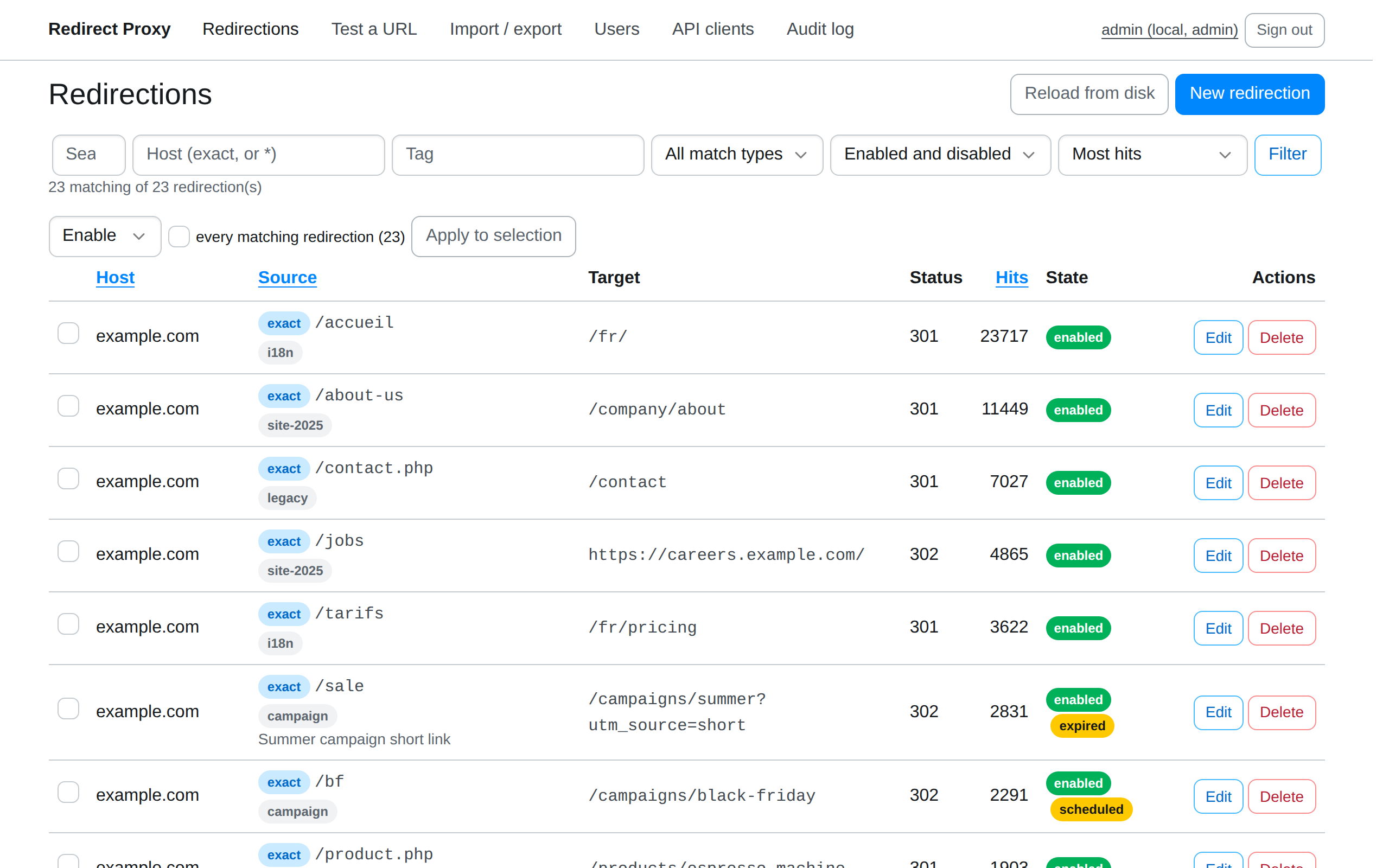
- Administration backend (Bootstrap 6, a pre-release):
- Create, read, update and delete rules, with search, filters (host, match type, state, tag) and sorting (source, host, hits, last hit, last update). Hit counts and the time of the last hit are kept across restarts, so rules nobody uses any more are easy to find.
- Enable, disable or delete a selection of rules, or every rule matching the filters, in one change.
- A "test a URL" tool that explains the result: every rule that matches, which one applies, which are shadowed or disabled, and the redirect chain.
- JSON and CSV import and export. An import can be previewed (rules added, changed and removed); a replace is always previewed first.
- Users, and an audit log with filters and a field by field diff.
- REST API with OAuth 2.0:
- A built-in client credentials token endpoint, with API clients managed in the admin or the CLI.
- JWT access tokens from your own authorization server are also accepted.
- An OpenAPI 3.1 document is served at
/api/openapi.json.
- Authentication:
- Local accounts (PBKDF2-SHA256).
- Optional OpenID Connect single sign-on.
- Optional trusted reverse-proxy headers.
- Access logs for the redirect, admin and API listeners, enabled by default:
- Combined, Common and JSON formats, or your own nginx-style template.
- Written to stdout, stderr or files (shared or one per listener), with rotation.
- GDPR-minded defaults: truncated IP addresses and no query strings.
- Plain files.
redirects.jsoncan be versioned, generated and edited by hand.- Reload it with
SIGHUPor a button in the admin.
Next: install it or go straight to the quick start.