
PHPUnit
Runs your PHPUnit tests without leaving the editor, and shows what came of them where you are working. Bundled with Porta and off by default — turn it on under Settings → Plugins → phpunit.
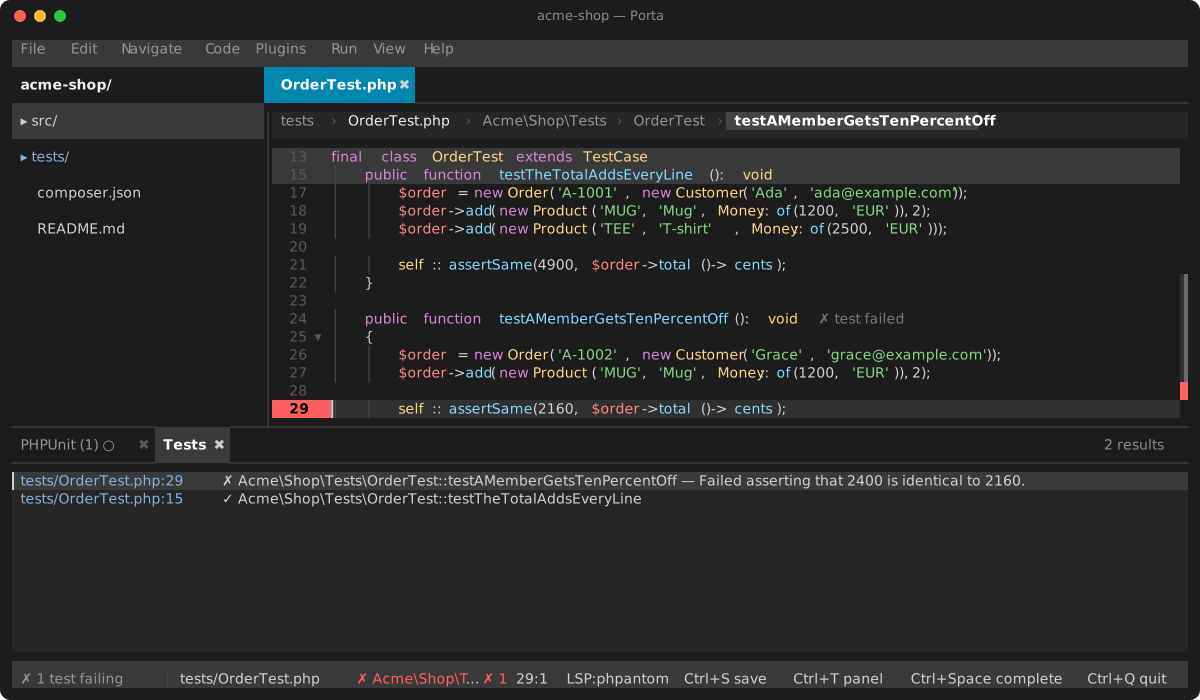
Six commands, in the Plugins menu and the command palette:
- PHPUnit: Run Test at Caret (
Ctrl+Shift+F10, or right-click in the editor) runs the test method the caret is in, every data set of it. Outside a test method it runs the whole file. A method is a test when its name starts withtest, or when#[Test]or a@testdocblock tag marks it. - PHPUnit: Run Tests in File runs every test in the file — the active one, or the one you right-clicked in the project tree or on a tab.
- PHPUnit: Run All Tests runs the suite your
phpunit.xmldescribes. - PHPUnit: Rerun Failed Tests runs again only the tests that failed or errored in the last run.
- PHPUnit: Run All Tests with Coverage runs the suite and measures which lines it runs — see Coverage.
- PHPUnit: Hide Coverage takes the coverage away.
Every file with unsaved edits is saved first, so PHPUnit tests what you see. When a save is refused — the file changed on disk under your edits, say — nothing runs, and you are told which file. The test run gets a PHPUnit terminal tab of its own, so PHPUnit's output is there to read in full. What it found shows up in four places:
- The Tests tab in the bottom dock lists each test, failures first, with the message.
Enterjumps to the line a failure points at, andF5runs the same tests again. - Each failure is a diagnostic on the assertion that failed. It shows inline, on the scroll stripe and in the Problems panel (
Alt+6). - Each test method of the file in front of you is marked
✓ test passed,✗ test failedor⊘ test skippedat the end of its line; a method with data sets takes the worst of them. - The status bar counts the failing tests until a run comes back green.
Each run replaces what the last one showed, so a run of one test clears the failures of the suite before it — and so does a run that ends with no report (stopped, or refused by its configuration). When every test passed but PHPUnit still exits with an error — a failOnWarning or failOnDeprecation in your phpunit.xml, say — you are told so rather than shown a green run: those findings are in the terminal tab, not in the results.
Pest
A project with Pest — a vendor/bin/pest — runs its tests with Pest instead, through the same commands: Pest reads PHPUnit's options and writes the same report. Run Test at Caret runs the test() or it() call the caret is in, under any describe() groups; outside every call it runs the file. A failure lands on the line Pest names, and each test's mark on its call. A phpunit binary you set in the settings is what runs, Pest project or not.
Coverage
PHPUnit: Run All Tests with Coverage marks, in each file the run measured, every statement in the change strip at the left of the line numbers: a thin green bar on a line that ran, a heavier red one on a line no test reached. Lines that are not statements — braces, signatures — show nothing. While a file shows coverage, the strip is coverage's: git's change marks come back when you run PHPUnit: Hide Coverage.
Editing a file moves its bars with their lines, and a line you change loses its bar. Saving the file takes its coverage away, since the run measured the code that was there before. F5 on the Tests tab measures again.
PHPUnit measures coverage with pcov or Xdebug in the PHP that runs it, over what <source> in your phpunit.xml names — either will do. Xdebug collects coverage only in its coverage mode, so a coverage run adds that mode for you: it starts PHPUnit with XDEBUG_MODE set to coverage, after any mode you already set (debug,coverage). pcov needs nothing. With neither, the tests still run and you are told there is no coverage. The strip is shown while git's Change marks in the gutter setting is on, as it is by default; with it off, there is nowhere to show coverage.
The plugin finds phpunit through its phpunit binary setting when you set one, then vendor/bin/phpunit, then your PATH. While none of those resolves, its menu entries stay dimmed, and its page under Settings → Plugins offers to install it (composer require --dev phpunit/phpunit). A test suite is the project's own code, so the plugin runs it only in a project you trust, and not in a project opened over SSH or FTP.
Settings
| Setting | Default | What it does |
|---|---|---|
| phpunit binary | empty | The executable to run; empty finds it as above |
Keys
| Key | Action |
|---|---|
Ctrl+Shift+F10 | Run the test at the caret |